LRDFIT
Authors: J. Menard, B. Davis, and D. Mastrovito (PPPL)
Last Updated: November 2011
Please note that LRDFIT is not currently working. NSTX-U staff are aware of this problem and have plans to address it. Updated installation and running instructions will be posted here when available.
LRDFIT Overview
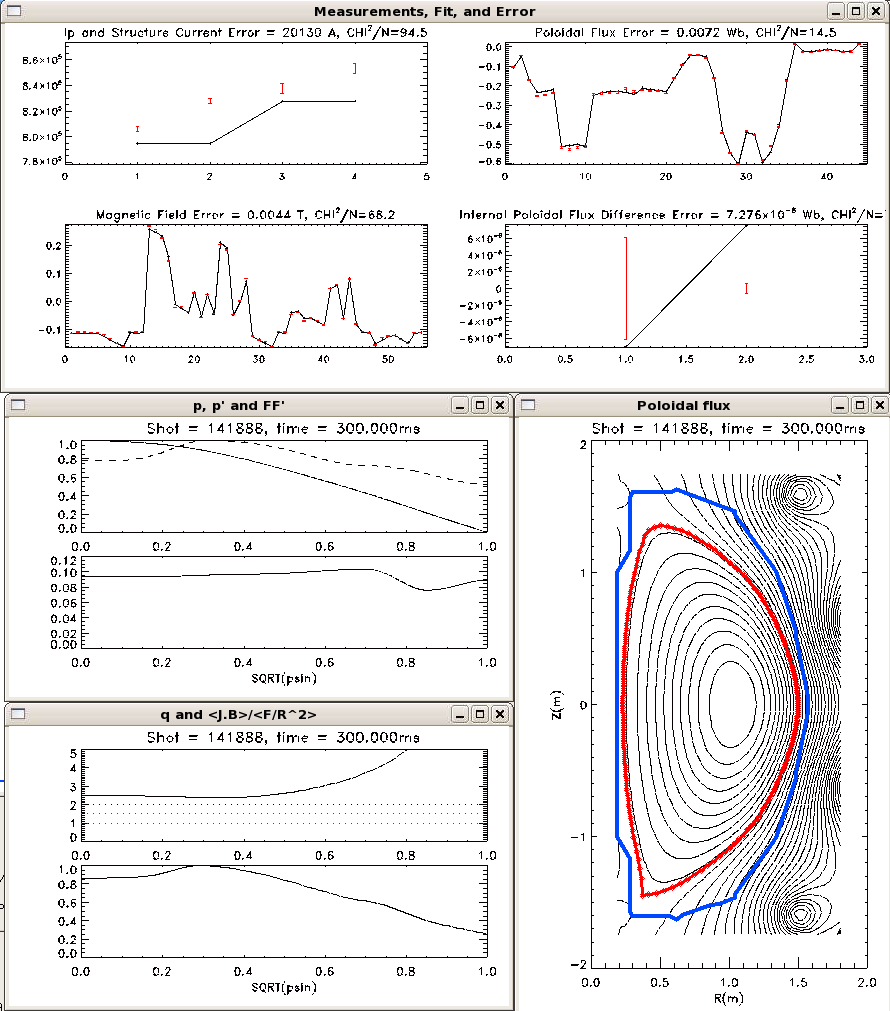
LRDFIT is an L-R (inductance-resistance) 2D axisymmetric circuit model of a tokamak which can be constrained to fit various combinations of diagnostic data. It is most commonly used for equilibrium reconstructions, but can also be used to predict time-dependent vacuum field evolution. For equilibrium reconstructions, the LRDFIT is run in 2 steps:
Step 1 - SVD fit to magnetics data to determine all toroidal currents in system- All toroidal currents in the system are determined consistent with the LR circuit model and a "best-fit" to the time-dependent magnetics data.
- The toroidal plasma current density is treated as unknown, and is allowed to flow anywhere inside the limiter boundary.
- Regularization (smoothing) of the plasma current density is utilized to produce an over-constrained system of equations.
- The Grad-Shafranov equilibrium force balance constraint is NOT enforced at this stage.
- The solution of this step provides a good estimate of all toroidal currents in passive conducting structures (vessel, passive plates, etc.)
- These passive structure currents are commonly treated at "known" in subsequent Grad-Shafranov constrained equilibrium fits
- Treating these currents as known: (a) produces similar results to fully time-dependent equilibrium fits, and (b) enables parallelization of the equilibrium fits
- The solution of this step also provides an initial poloidal flux distribution for the Grad-Shafranov constrained equilibrium fits
- The passive conductor currents are treated as known and the coil currents are fit
- The magnetics data, MSE data, electron temperature iso-surfaces, etc. are used as constraints on the equilibrium fit
- Basis functions for the p' and FF' profiles are specified, and the "best-fit" weighting of the basis functions is determined
- The results for individual time-slices are written to files
- The code can be run interactively, or in parallel/batch mode
- In batch mode, after multiple time-slices have been computed, time dependent quantities are computed, and the results are archived in MDS+
Version History
Version 3
May 2010
- Updated installation instructions
October 2008
- Ported LRDFIT from 32 bit RHEL3 to 64 bit RHEL4
- Added user specification of arbitrary radial and vertical grid dimensions of reconstructions
- Minimum resolution is 33x33, maximum is 513x513
- Reconstruction GUI window aspect ratio changed to fit on smaller laptop screens
- Minimum reconstruction time-step reduced from 1 ms to 0.1ms (FUTURE)
Version 2
June 2006
- Extended to reconstruct plasmas for years 2003 and later (shots 109256 and above)
- Installation methodology of new LRDFIT versions improved
Version 1
2005
- Initial version of code written for use with FY2006 shots and above
- This is the first version of LRDFIT shared with the NSTX research team