 |
|
|
|
|
|
|
|
|
|
|
 |
|
 |
 |
 |
 |
|
||||
 |
 |
 |
 |
 |
||||||
 |
 |
|||||||||
Getting Started looking at NSTX Data
Users looking at output data from NSTX shots tend to use Web Tools or programs written for X-windows. If you want to log onto the PPPL Linux cluster for the first time see New NSTX User Setup.
Finding signal names is probably the hardest part of looking at data that interests you. One of the two Web Tools shown at signalnames.html should help, and, of course, the cognizant physicist is always the best source. idl_class2.html shows you how to read signals and their units from the IDL language (either from X-windows, or on your Mac or PC), as does mdsaccess.html from the web.
To find shots you are interested in, see pages at SEARCHING/COMPARING/LISTING. Database searches may help you find shots of interest, so see searchefitdb.html or weblogplus.html might help you find shots. The IDL program DbAccess (if you have done a "module load nstx" on the Linux cluster in an X-window) has many more gory details, but there isn't much guidance on which tables to use.
Once you know your signals and shot numbers, you can look at them with the plotting tools from one of many Web PLOTTING OPTIONS. The scope program is the most commonly-used program for looking at MDSplus data. You can browse for scopes in /p/nstxops/util/scopes (plottable from mdsscopeadj.html) or jScopes in /p/nstxops/util/jscp/. Since jScope allows overlaying traces in a particular frame, users may prefer it over scope. The "physics scope" would be good for seeing general information about shots:
   cp /p/nstxops/util/jscp/physics.jscp physics.jscp
   jScope physics.jscp
Physics operators have been keeping some of their jScope files in /p/nstxusr/physops/scopes
Users usually use scope and jScope by connecting to the PPPL Linux cluster with an X-window, but MDSplus can be installed directly on a PC or a Mac. Scopes in the /p/nstxops/util/scopes/ directory on the Linux cluster may also be plotted on the web from the NSTX MDSplus Adjustable Scope Plotting Tool.
EFIT data can be viewed from EFITviewer, run from the command line on the PPPL Linux Cluster (in an X-window).
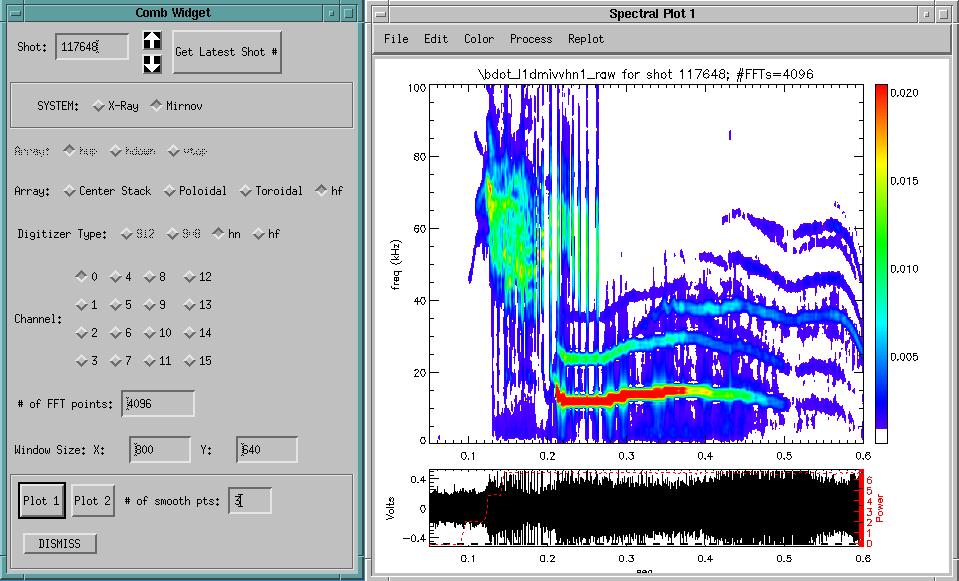
combw3.pro, adapted from a program by Eric Fredrickson, lets you look at spectra from Mirnov data and X-ray data. You can browse through plots at http://nstx.pppl.gov/nstx/SpecFit for toroidal mode number.
See the Digraph List or NSTX_diagnostics.html for various diagnostics.
See WhatsNew.html for other examples of NSTX software of general interest. See Data_Analysis_Tools_for_NSTX-U.pdf for more extensive examples of locally-developed tools.
Last modified
03-Apr-2014
For questions, contact Bill Davis